Gnarled Helix LLC

We start every product with a question:What's a mechanic nobody's tried yet?

About the studio

Gnarled Helix LLC, founded in 2022 to build an educational programming game, is a small remote-first game studio. We seek to deliver new takes on classic game mechanics and useful tooling for developers.

Our first experiment was Open Sourcerer. But we didn't just build a game — we built an engine from scratch, focused on web-first delivery and performance, and that engine led to the two products that followed.

01What if your army was the factory?

Factory Chess

Playable prototype · free in your browser · Play the prototype

Chess, on the same sixty-four squares as a working factory. Captured pieces leave scrap where they died. Park a pawn on the heap to mine it, lay belt to haul the ore to a bishop to be refined, and on to a rook that smelts it into new pieces.

Every turn is a chess move plus two belt parts — so industry never costs you tempo. It costs you board space.

That second sentence is the whole design. Factory Chess is a chess variant in the strict sense — the pieces move the way they always have, and check is still check — grafted onto an automation game in the equally strict sense: belts route material, pieces transform it, and a lane you laid three turns ago keeps producing whether or not you're watching it. The resource management isn't a layer sitting on top of the chess; it is the chess. The belts you lay eat the board you fight on, and a pawn parked on a heap is a pawn off the front line.

So familiar judgements change weight. A material lead stops being a count and becomes future production, if you can hold the ground long enough to process it. A sacrifice can be an investment, if the scrap it leaves falls where you can work it. And a winning position can rot while you press the attack, because the factory behind it needs tending too.

The board in this section is a recorded game — the pieces, the belts, the cargo in motion are all real output from the engine. The playable build is at factorychess.com: free, in the browser, nothing to install, and you play against that same engine, which has to weigh the same questions you do.

It is a prototype and we are looking for players rather than customers. Things will be rough and some of them will be wrong, and that is the part we want to hear about. The fastest way to understand it is to lose one game to your own conveyor belts.

02What if your spells were code you wrote?

Open Sourcerer

In development · Wishlist on Steam

A 2D platformer where you write your spells in JavaScript and use them to solve puzzles and defeat enemies.

The spells aren't spell-flavoured menu options. They're real JavaScript, written in an editor inside the game and run by a sandboxed interpreter — with the same syntax errors, the same off-by-ones, and the same satisfaction when a loop finally does what you meant. That makes this a programming game in the literal sense: the thing you get better at, as you play, is writing code.

We're approaching programming education fun-first. We won't prepare you for a job in software engineering — we want to show you whether you enjoy it.

That's also what makes it a coding game for beginners: it assumes nothing — not a class, not a typing speed, not a conviction that you're a computer person. You learn JavaScript the way the game teaches everything else: because the next room needs it. And the fun-first commitment cuts both ways — a mechanic that's only fun because it's teaching something isn't fun, and doesn't ship.

The game itself is unreleased — in development, with a Steam page where you can wishlist it and watch it take shape. The engine underneath is already working: we built it from scratch for web-first delivery, and it went on to power everything else we make. The spell demo in this section runs on the same idea — the code in that editor really executes, in a sandbox, and the character really does what it says — though the game's spell API runs a great deal deeper than the demo's.

03What if a level editor were multiplayer?

Tauric Studio

Free today · tauric.tools

A 2D map and graphics editor where artists and game designers build levels together, in real time.

Level editors have mostly stayed single-player long after every other design tool learned to share a document. Tauric Studio is our answer: a collaborative level editor where everyone opens the same map and an edit lands for everyone the moment it's made. A designer can block out geometry while an artist dresses it — same file, same minute — and the usual round trips of export, send, import, and merge simply never happen.

It isn't tied to any one engine, by construction. Entity types come from the assets you upload rather than from game code, so the editor never needs to know what your runtime calls a spawn point — you define it, place it, and your importer decides what it means. Maps save to a compact protobuf format, and because it's a browser level editor there's nothing to install — for you, or for anyone you're editing with.

If you're using Tiled today, keep using it. Tauric writes Tiled TMJ directly, so the two sit in one pipeline rather than in competition: author where each tool suits the work, pass the map across, and the importer at the end never knows which end it came from. What Tauric adds to that pipeline is everyone in the same document at once. The TMJ export sits alongside GeoJSON, SVG, and DXF/DWG — the DXF export is there because a 2D map is, structurally, a drawing, and sometimes the next tool that wants it is CAD.

The protobuf is the source of truth — keep that in version control and generate the exports from it, rather than checking in artifacts that drift out of date. Tauric Studio is free, and live today at tauric.tools.
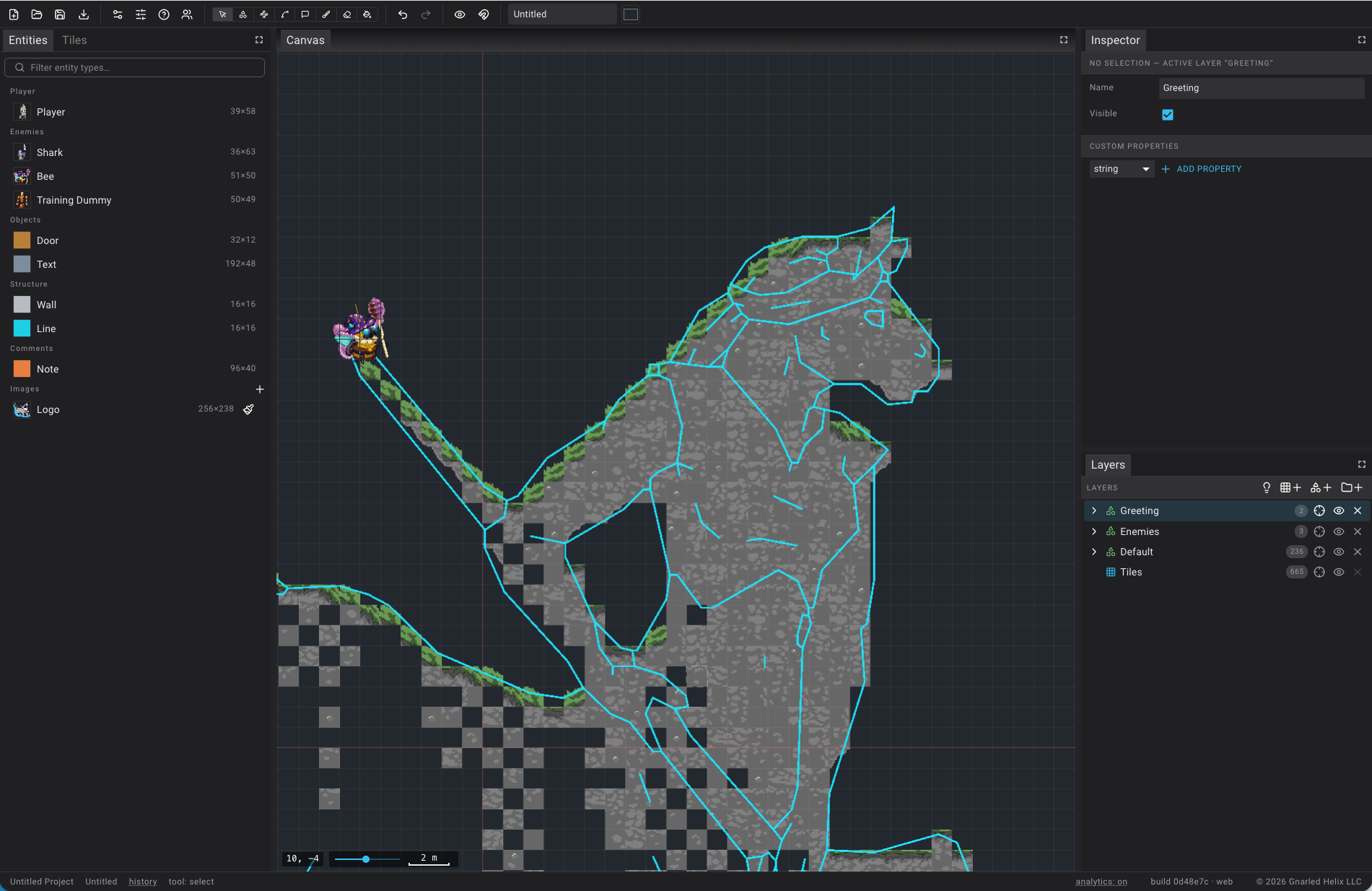
The Tauric Studio editor: an entity palette on the left listing a
            player, enemies and objects, a canvas where a level is being drawn as
            cyan outlines over tiles, and inspector and layer panels on the right.

Giving back

Open source

We contribute back to the open source community. Gnarled Helix has published the three-aseprite and protosprite rendering packages for anyone to use — and protosprite is drawing the characters on this page.

Who builds it

Core Team

Robert Brownstein

Founder

Robert Brownstein founded Gnarled Helix in 2022 while working for Boston Dynamics and leads engineering across the studio's products. He began prototyping Open Sourcerer in 2018 and rebuilt it in 2021 as a from-scratch TypeScript engine architected for web-first delivery — the engine the studio's later products are built on. He is the author of its open-source rendering packages, three-aseprite and protosprite, both released under MIT.

Alvin

Engineer

I'm a software engineer who got my start in game development through Game Maker Studio. That early curiosity grew into building my own 2D game engine from scratch in C, and into contributing to the games we make at Gnarled Helix! The work I'm proudest of lives in the Open Sourcerer engine. I introduced behavior trees for entity AI, giving designers a composable way to author enemy logic, and overhauled the camera system to drive cutscene sequencing and dynamic camera zones throughout our levels.

Bruno Cortés

Lead Pixel Artist

Bruno Cortés is a lead artist and pixel animator with over 10 years of experience across games, advertising, and interactive media. He's built his career on adapting to a project's visual language and pushing it further — blending craft with a sharp eye for mood and atmosphere. Based in Mexico.

Jan-Nikolay Jäckel

Lead Concept Artist

Jan-Nikolay Jäckel, better known as "Hatwolf," is a Concept Artist at Gnarled Helix LLC, specializing in character, prop, environment and UI design, as well as high-polish illustrations. Alongside their work at Gnarled Helix, they continue to work as a freelance artist for a range of clients, including YouTubers, Streamers, and independent game development teams, contributing artwork to visual novels and other games. Their work is rooted primarily in fantasy, drawing on their background in the furry art community and a long-standing passion for expressive, character-driven designs. They are also the creator of the award-winning worldbuilding project After Silence, for which they develop both the writing and artworks.

Get in touch

Contact us

info@gnarledhelix.com